
Why Your Wardrobe Matters More Than You Think
In Dubai, your home is a statement. From the marble floors of a Palm Jumeirah villa to the sleek interiors of a Downtown apartment, every detail counts — and your wardrobe is no exception.
Yet most homeowners in the UAE spend months obsessing over their kitchen or bathroom renovation, only to treat the wardrobe as an afterthought. The result? Cramped shelves, wasted corner space, and a bedroom that never quite feels finished.
A well-designed luxury wardrobe does three things at once: it organizes your life, elevates your room’s aesthetic, and adds real value to your property. In a market like Dubai — where quality is expected and style is non-negotiable — choosing the right wardrobe design is one of the smartest investments you can make.
This guide covers everything you need to know: the most popular luxury wardrobe styles in Dubai, what materials actually hold up in the UAE climate, realistic cost ranges, and how to choose what’s right for your home.
What Makes a Wardrobe “Luxury” in Dubai?
The word “luxury” gets used loosely in interior design, so let’s be specific about what it means in the Dubai context.
A luxury wardrobe in Dubai typically features:
- Fully bespoke or semi-custom construction — built specifically for your room dimensions, not bought off the shelf
- Premium materials — lacquered MDF, solid wood, Italian melamine, or metal-frame systems with soft-close hardware
- Smart internal organization — dedicated zones for shoes, accessories, folded clothes, hanging garments, and even handbag displays
- Integrated lighting — LED strip lights inside the wardrobe that activate when doors open
- Refined finishes — high-gloss lacquer, matte textures, wood veneer, or mirror panels that complement the room’s overall design
Quality hardware — soft-close hinges, hydraulic lift mechanisms, smooth glide drawer systems, and anti-dust seals
Budget flat-pack wardrobes (like those from IKEA) serve a purpose, but they don’t offer the structural quality, customization, or finish that Dubai’s luxury homes demand. Custom and semi-custom solutions built by local renovation specialists are what truly qualify as luxury wardrobes in this market.
structural quality, customization, or finish that Dubai’s luxury homes demand. Custom and semi-custom solutions built by local renovation specialists are what truly qualify as luxury wardrobes in this market.
Not every Dubai homeowner wants visual drama. Many — particularly those in modern apartments in Downtown Dubai, City Walk, or DIFC — prefer interiors that are clean, calm, and clutter-free. Minimalist wardrobes serve this aesthetic perfectly.
What defines a minimalist wardrobe:
- Handle-less doors (push-to-open or recessed J-pull handles)
- Flush flat-panel fronts with no decorative detailing
- Matte finishes (white, linen, stone grey, or soft taupe)
- Concealed hinges and invisible joinery
- Simple, functional internal layout
The beauty of a minimalist wardrobe is that it disappears into the room — drawing no attention to itself, which allows other design elements (the bed, artwork, or a statement wall) to take center stage.
Cost range: AED 8,000 – AED 30,000
8. Wooden Wardrobes with Luxury Touches — Warmth Meets Elegance
Solid wood and wood-veneer wardrobes bring warmth and natural texture to a bedroom — a welcome contrast to the concrete, glass, and steel that characterizes much of Dubai’s built environment.
Wood types and finishes popular in Dubai:
- Walnut veneer — rich, dark, luxurious; popular in DIFC and Downtown apartments
- Oak — light, natural, Scandinavian feel; suits villa interiors in The Meadows or Springs
- Wenge — very dark, dramatic; often used in master bedroom wardrobes in high-end villas
- White-wash oak — bright, airy, coastal feel; popular in JBR and beachside properties
Luxury touches on wooden wardrobes include: brass or matte black hardware, integrated LED strip lighting, carved panel detailing, and combination finishes (e.g., wood frame with lacquered insert panels).
Important for Dubai climate: Solid wood can be affected by temperature fluctuations and humidity. Choose a reputable contractor who uses properly kiln-dried timber and applies the right sealing finishes for indoor UAE environments.
Cost range: AED 12,000 – AED 55,000+
9. Corner Wardrobes — Smart Use of Every Centimeter
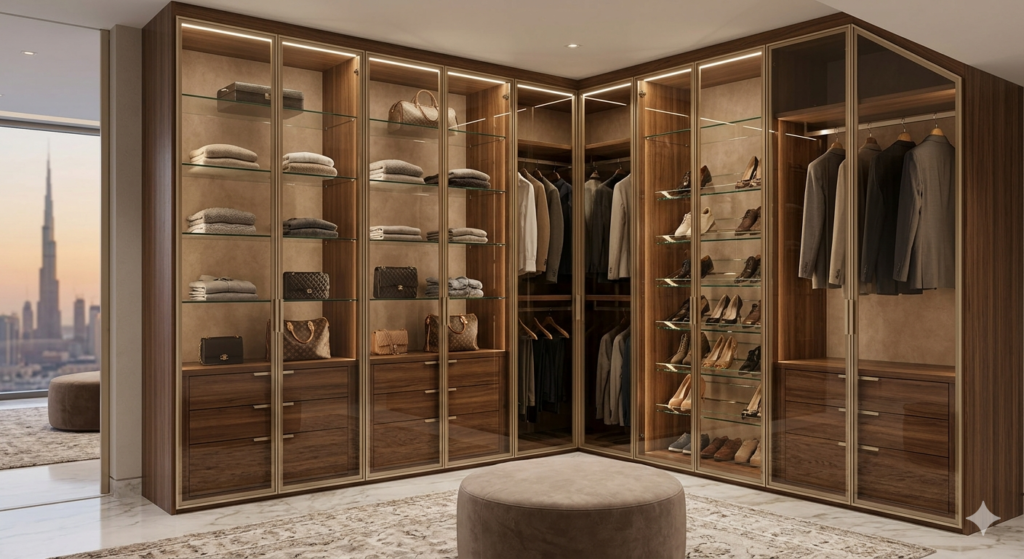
Corner wardrobes make use of the L-shaped dead space that exists in most bedrooms — space that would otherwise be wasted or awkwardly furnished. They are particularly useful in apartments where every square foot matters.
Two common configurations:
- L-shaped corner wardrobe — two wings meeting at a right angle; maximizes storage
- Diagonal corner unit — a angled door at the corner; works better in rooms with furniture placement constraints
In Dubai’s high-rise apartments, corner wardrobes are often specified for second or third bedrooms (children’s rooms or guest rooms) where you need to maximize storage without overcrowding the space.
Cost range: AED 7,000 – AED 28,000
10. Modular Wardrobes — Flexible, Scalable, Future-Proof
Modular wardrobes are pre-engineered units that can be combined and reconfigured in multiple ways. Think of them as a highly elevated version of flat-pack furniture — the same flexibility, but with premium materials, proper installation, and a completely custom look.
Why modular works well for Dubai’s rental market: Dubai has a significant proportion of residents who move homes every few years. A modular wardrobe can be disassembled, transported, and reassembled in a new apartment — making it a smarter investment for those who don’t own their property.
Key advantage: Unlike fully bespoke built-ins, modular systems can be updated or expanded as your needs change — add more drawers, switch out hanging rails for shelving, or add a new module when your wardrobe grows.
Cost range: AED 5,000 – AED 22,000
How to Choose the Right Wardrobe Design for Your Dubai Home
With so many options available, the choice can feel overwhelming. Here’s a practical framework to guide your decision.
Step 1: Assess Your Space
Measure your room carefully — width, height, and depth available. In Dubai apartments, standard ceiling heights range from 2.7m to 3.2m; in villas they can reach 4m or higher. This determines whether you go floor-to-ceiling (maximizing storage) or leave a gap at the top.
Step 2: Understand Your Storage Needs
Before choosing a style, audit what you actually own. How many hanging garments do you have? Do you need dedicated shoe storage? Do you have formal wear like abayas, suits, or kanduras that require extra-long hanging sections? Your internal configuration should be designed around your real wardrobe — not a generic layout.
Step 3: Match It to Your Interior Style
Your wardrobe should complement your bedroom’s existing design language:
- Modern/Contemporary → Sliding doors, high-gloss finishes, minimalist handle-less designs
- Classic/Traditional Arabic → Wood veneer with brass hardware, carved panel details
- Scandinavian/Neutral → Matte oak or white-wash finishes, simple forms
- Bold/Dramatic → Dark lacquer, full mirror, integrated LED lighting
Step 4: Set a Realistic Budget
In Dubai, quality custom wardrobes start at around AED 6,000–8,000 for a basic built-in, and can easily exceed AED 50,000–80,000 for a full walk-in dressing room with premium materials. Mid-range projects (AED 15,000–35,000) typically offer the best balance of quality and value.
Step 5: Choose the Right Contractor
This is arguably the most important step. The quality of installation is just as important as the design itself. Look for:
- A contractor with a physical showroom in Dubai (so you can see material samples in person)
- Portfolio of completed projects in similar properties
- Clear warranty on both materials and installation workmanship
- Transparent pricing with itemized quotes
Common Wardrobe Design Mistakes to Avoid in Dubai
Skipping a humidity-resistant material finish: Dubai’s interiors are heavily air-conditioned, which can cause moisture fluctuations. Always specify moisture-resistant boards and proper finishing for wardrobe interiors.
Under-estimating shoe storage: Shoe collections in UAE households tend to be larger than average. Always allocate more shoe space than you think you need.
Choosing gloss finishes in high-traffic family rooms: High-gloss is stunning, but shows fingerprints easily. In children’s rooms or shared family spaces, matte finishes are far more practical.
Going too dark in a small room: Dark-finish wardrobes look amazing in large master bedrooms, but can make smaller rooms feel claustrophobic. In compact spaces, lighter finishes or mirrored panels are the smarter choice.
Forgetting internal lighting: Internal LED lighting is one of the most appreciated features in any wardrobe. It costs very little to add during construction and makes a huge difference in daily usability.
Wardrobe Design Trends in Dubai for 2025
Dubai’s interior design market evolves quickly, and wardrobe trends are no different. Here’s what’s popular in the UAE right now:
- Fluted wood panels — vertical ribbed textures on wardrobe fronts; adds depth and tactile interest
- Brushed brass hardware — replacing the chrome and black matte hardware that dominated the last decade
- Integrated vanity units — wardrobes built around a central dressing table, with mirror and lighting
- Sustainable materials — FSC-certified wood, low-VOC lacquers, and recycled content boards are increasingly requested by eco-conscious clients
- Smart wardrobes — motorized hanging rails, app-controlled LED lighting, and climate sensors for wardrobe interiors are emerging in ultra-luxury projects
Frequently Asked Questions
What is the average cost of a custom wardrobe in Dubai? Custom wardrobes in Dubai typically range from AED 6,000 for a basic built-in to AED 60,000+ for a full walk-in dressing room. Most mid-range bedroom projects fall between AED 12,000 and AED 30,000.
How long does it take to install a wardrobe in Dubai? Depending on complexity, a standard built-in wardrobe takes 2–5 working days from fabrication to installation. Walk-in wardrobes or complex multi-room projects may take 1–2 weeks.
Is a built-in or freestanding wardrobe better for Dubai apartments? Built-in wardrobes are almost always better for Dubai apartments. They maximize space utilization, create a cleaner aesthetic, and are built to fit the exact dimensions of your room — which is especially important in apartments where every square meter counts.
Can I take my wardrobe with me when I move? Built-in wardrobes are generally fixed and left with the property. Modular wardrobes, however, can be disassembled and reinstalled in a new home — making them a practical option for renters or those who move frequently within Dubai.
Do I need NOC or permission for a wardrobe fit-out in Dubai? For standard bedroom wardrobes, no approval is typically needed. If your wardrobe installation involves electrical work (such as integrated lighting), ensure your contractor is licensed to carry out such work in the UAE.